The 50/30/20 Rule Explained (With Real Numbers)

The 50/30/20 budget splits take-home pay into needs, wants and savings. Simple, popular — and here is exactly how to apply it with real dollar amounts.
The split
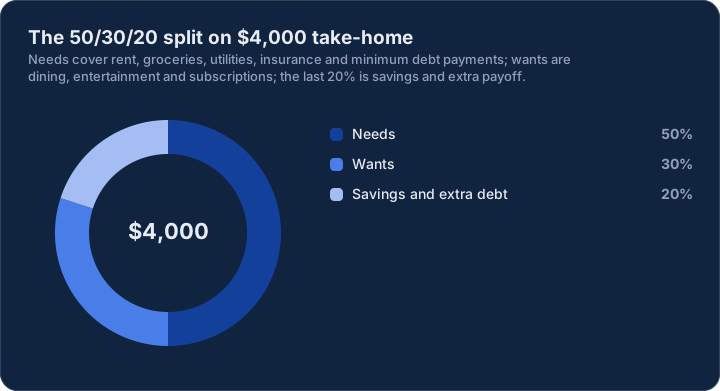
50% of take-home pay to needs (rent, utilities, groceries, insurance, minimum debt payments), 30% to wants (dining out, entertainment, subscriptions, hobbies), 20% to savings and extra debt payoff. On $4,000 take-home: $2,000 needs, $1,200 wants, $800 savings.
Why it works when line-item budgets fail
Traditional budgets fail because they ask thirty micro-decisions a month. The 50/30/20 rule asks one: is this a need, a want, or savings? Three buckets, sorted automatically by any expense tracker, turn budgeting from accounting into a sorting exercise.
When your numbers do not fit
In high-rent cities needs often run 60-65%. Treat the rule as a diagnosis, not a law: if needs exceed 50%, that gap IS the budget project — housing is the only lever big enough to matter. If savings sit under 20%, start at 5% and raise one point a month; the habit matters more than the number.
Track it automatically
Our free tracker auto-sorts every entry into needs, wants or savings, so the split is visible the moment you open the month view — no spreadsheet formulas required.
A full $4,000 month, mapped line by line
Take the median-ish take-home of $4,000 and the rule becomes a complete monthly plan you can compare yourself against. Needs get $2,000: rent $1,150, groceries $480, utilities and phone $220, insurance and minimum debt payments $150. Wants get $1,200: dining out and coffee $360, entertainment and streaming $180, shopping $300, hobbies and the rest $360. Savings and extra debt get $800: a $400 automated transfer on payday splits into emergency fund and investing, and $400 of extra principal turns a 22% card balance into a two-year project instead of a fifteen-year one. Run your own numbers side by side with this table — the line where your reality diverges is your budget project.
| Bucket | Line | Amount |
|---|---|---|
| Needs (50%) | Rent / mortgage | $1,150 |
| Needs | Groceries | $480 |
| Needs | Utilities & phone | $220 |
| Needs | Insurance & minimum debt payments | $150 |
| Wants (30%) | Dining out & coffee | $360 |
| Wants | Entertainment & streaming | $180 |
| Wants | Shopping | $300 |
| Wants | Hobbies, fun, everything else | $360 |
| Savings (20%) | Automated transfer on payday | $400 |
| Savings | Extra debt payoff / investing | $400 |
Frequently asked questions
Is 50/30/20 before or after taxes?
After taxes — use take-home pay, or the math becomes impossible for most earners.
Does a car payment count as a need?
Yes — transport to work is a need; the portion above a basic transport cost is arguably a want.