Emergency Fund Calculator

Enter your monthly essential spending and see what a 3-, 6- or 9-month emergency fund means in dollars — and how long it takes to get there at any monthly contribution.
How to use this calculator
Run the numbers once, write the result where you will see it, and let the free expense tracker do the weekly work: it sorts every entry into needs, wants and savings automatically, so drift from the plan is visible the moment it starts instead of at the end of the month. A calculator sets the target; tracking is what actually gets you there.
Which target is right
Three months covers a job gap for dual-income households with stable work; six months is the standard for single-income households, freelancers and anyone whose industry hires slowly; nine months suits volatile fields and health-cautious families. The target is peace-of-mind math, not a trophy: pick the smallest number that lets you sleep, and raise it after the first real emergency teaches you your actual burn rate.
Essentials only — that is the point
The fund replaces rent, food, utilities, insurance and minimum debt payments during an emergency — it does not replace your lifestyle. That is why the calculator starts from essential spending, not take-home: funding nine months of full spending is a two-year project nobody finishes, while nine months of essentials is reachable in one.
Where to keep it
High-yield savings account, separate from checking, no debit card attached — one transfer per month in, zero transfers out without a named emergency. The friction is the feature: money that takes two days to reach pays for genuine emergencies and quietly ignores impulse ones.
A worked example on $4,000 take-home
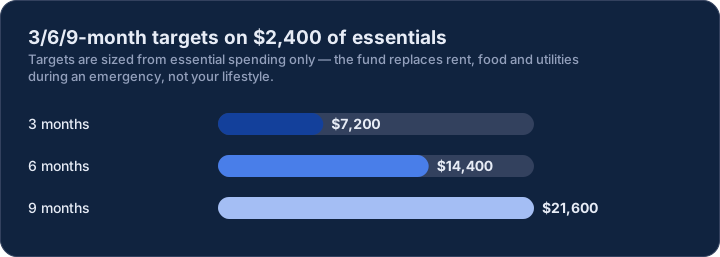
Say essentials run $2,400 a month — rent $1,340 trimmed to what a crisis month would really cost, groceries $420 cooked at home, utilities $200, insurance and minimums $240, transport $200. The 3/6/9 targets are $7,200, $14,400 and $21,600. Six months at $400 a month is exactly three years; add $100 more — one dinner out a week — and the same fund lands in twenty-nine months. Start the first $2,400 as a sprint and the plan gets shorter still: one month of essentials inside ninety days is what stops a job scare from becoming card debt, and that first month does most of the fund’s psychological work.
How to use the schedule and the chart
The chart plots your balance climbing toward a dotted line — the six-month target on your numbers — so you can see at a glance whether the climb feels bearable or brutal; a line that crawls along the bottom for years is the picture version of “raise the monthly amount”. The month-by-month table underneath is the accountability half: it exists to be checked after each automatic transfer, one row at a time. If the “saved so far” column stops matching your actual balance for two months running, the plan has silently failed somewhere — a skipped transfer, a fee, a raid for a non-emergency — and two months is early enough to restart without losing the habit.
Frequently asked questions
Emergency fund or pay off debt first?
One month of essentials in cash first, then attack high-interest debt, then build toward the full target — the starter month is what stops new debt while you pay the old.
Is my emergency fund too big?
Past twelve months of essentials, excess is an investment decision, not safety — move the surplus to long-term investing.
What counts as an emergency?
Job loss, medical bills, essential home or car repairs. A sale, a vacation and the new phone are not emergencies — that is what the wants bucket is for.