7 Best Mint Alternatives in 2026 (After Mint Shut Down)

Intuit shut Mint down in 2024 and moved users to Credit Karma — which dropped budgeting features entirely. Seven alternatives actually worth your time.
What Mint users actually lost
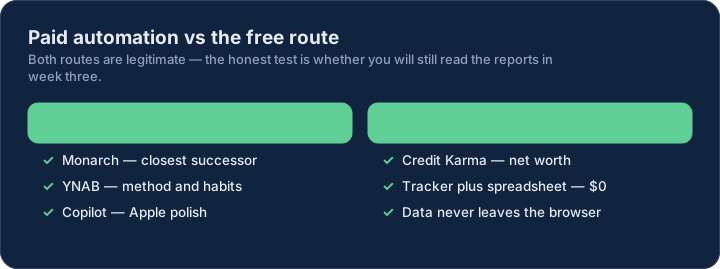
The killer feature was passive: connect accounts and transactions auto-categorized across years of history. Most replacements kept the connections but charge for what Mint gave free — Monarch (subscription), YNAB (subscription or annual plan), Copilot (subscription). The free tier is where the market split.
The paid picks
Monarch is the closest one-to-one replacement — connections, rules-based categorization, goals, and constant shipping since the shutdown. YNAB is the strictest and most transformative: zero-based budgeting where every dollar gets a job, with a real learning curve and a devoted following. Copilot is the polish pick for Apple-first households.
The free picks
Credit Karma handles net-worth tracking but budgets are thin. Our take: pair a free spreadsheet with the tracker on our homepage — it covers the categorization Mint users actually miss, costs nothing, and data never leaves the browser.
How to choose in ten minutes
Zero effort: Monarch. Habit change: YNAB. Free and private: our tracker plus a spreadsheet. Do not pay annually anywhere on month one — every option here has a monthly plan or trial for exactly that reason.
The migration nobody plans for
Whichever replacement you pick, the real cost is the switch itself: two months of double-entry while you trust the new tool, one weekend of recategorizing, and the moment you realize the old Mint history is a CSV you should have exported before the shutdown — if you still have it, import it wherever you land; history is the part no app can regenerate. This is also the argument for the boring route: a tracker whose data lives in your browser and exports to a four-column CSV can never strand you like this again. Tool loyalty is expensive; data portability is the loyalty that pays.
What Mint users should keep from the experience
The valuable part of Mint was never the software — it was the passive awareness: a place where the whole financial life was visible without effort. Any replacement preserves that awareness only if you keep the review habit alive, because the failure mode of every successor is the same: auto-import keeps running while the reading stops. Decide on day one when the weekly ten-minute look happens — Sunday coffee, Monday lunch, any fixed slot — and the replacement succeeds regardless of which row of the table above you picked. The tool is a fork; the habit is the meal.
| Pick | Free tier | Choose it for |
|---|---|---|
| Monarch | trial only | the one-to-one Mint successor |
| YNAB | students: one year free | zero-based method and habit change |
| Copilot | trial only | Apple-first households |
| Credit Karma | free | net worth; budgets are thin |
| SpendKit tracker + CSV | free forever | privacy and the 10-second habit |
Frequently asked questions
Is Mint really gone?
Yes — Intuit closed it on March 23, 2024, folding users into Credit Karma, which lacks the budgeting features.
Are bank connections safe?
All use read-only aggregators like Plaid; risk is low but real — the spreadsheet route avoids it entirely.