How to Track Expenses (and Actually Stick With It)

Tracking expenses is the highest-leverage money habit — but most people quit within two weeks. Here is the version that sticks.
Step 1: Make it 10 seconds a day
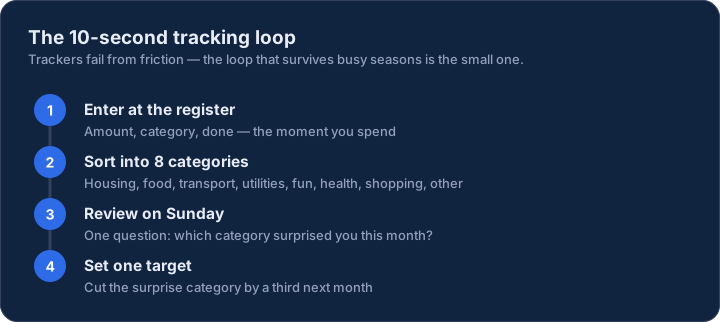
Trackers fail from friction: a system that takes a minute per entry dies by Wednesday. Ours takes about ten seconds — open, type an amount, tap a category. Enter it the moment you spend; waiting until the weekend turns a 10-second habit into a weekend-long archaeology project.
Step 2: Use 8 categories, not 40
Every expense lands in one of eight buckets: housing, food, transport, utilities, fun, health, shopping, other. Forty micro-categories create data you will never read. Eight buckets create patterns you can act on — "fun is 30% of my spending" is actionable; "coffee was $4.20" is not.
Step 3: Review weekly, not daily
Daily tracking, weekly review. Every Sunday open the month view and ask one question: what surprised me? Surprises are where budget leaks live — forgotten subscriptions, doubled delivery fees, a category quietly creeping.
Step 4: Give next month one target
Once you can see last month honestly, set one target — not twelve. Cut the surprise category by a third and you have a working budget, ahead of the two-thirds of households that have never tracked a full month.
When tracking becomes automatic
Around month two or three the habit flips: you will catch yourself mentally categorizing a purchase before you reach for the phone, and that is the sign the system has moved from discipline to reflex. Nothing about the method changes — entries stay ten seconds, reviews stay weekly — but the mental load drops to nearly zero, and the monthly review becomes the only maintenance the system asks for. That is the whole lifecycle: ten seconds a day, ten minutes a week, and a number you nudge once a month. Anything more elaborate was never going to survive a busy season anyway.
Cash and the rules that make it stick
Two small rules keep the record honest. Cash goes in the same day, even as a rounded guess — a $5 error beats a hole in the log, and cash holes are how tracking quietly dies. And the entry happens at the register, not at home: the number of people who remember a purchase drops by half in an hour and by half again by dinner. Stand still, type the amount, tap the category, go. Those are the ten seconds the whole system runs on.
| 1 | Open the month view and scan the category bars — which one surprised you? |
| 2 | Read the surprise category’s entries: one-off, trend, or forgotten subscription? |
| 3 | Check the surprise against its healthy cap (the category table). |
| 4 | Pick one number to change next week — never more than one. |
Frequently asked questions
How long should I keep tracking?
Forever, but intensity can drop — most people move to spot-checks after three months once they know their baselines.
Cash spending?
Enter it the same way; the tracker only works if everything lands in it.