How to Save Money Each Month: The Levers That Move

Saving more is not willpower — it is pulling the two or three levers that move real money, in the right order.
Lever 1: The big fixed costs
Housing, transport and insurance are 60-70% of most budgets — a 10% cut here beats eliminating every latte. Shop insurance annually, question the car payment, and if housing is above 35% of take-home, that is the only conversation worth having this year.
Lever 2: The recurring leak
Subscriptions are designed to be forgotten. List every recurring charge (the tracker’s subscriptions bucket makes this a two-minute job), cancel anything unused in sixty days, and calendar-reminder every annual renewal a month before it fires.
Lever 3: Automate before you see it
A standing transfer on payday — even 5% — saves more reliably than any spending diet, because the money is gone before the month’s decisions begin. Raise it one point a quarter; by month twelve you are saving 17% without noticing.
What does not work
Daily willpower budgets, cash envelopes for digital spenders, blanket "skip the coffee" rules — all fail structurally, not personally. Track first, find the two big levers, automate them. That is the whole method.
What the levers pay on $4,000 a month
Levers are only persuasive when they carry dollar figures. On a $4,000 take-home, reshoping car and renters insurance at renewal typically moves $25-60 a month; canceling or rotating the forgotten subscriptions the tracker surfaces, $20-70; cooking four more meals at home rather than delivery, $80-140; right-sizing a phone plan to an MVNO, $20-40. The two big levers dwarf all of that: a housing share moving from 34% to 28% is $240 a month, permanently. Pull one small lever this week and price one big one this year — the table below is the order to try them in.
Sequence beats intensity
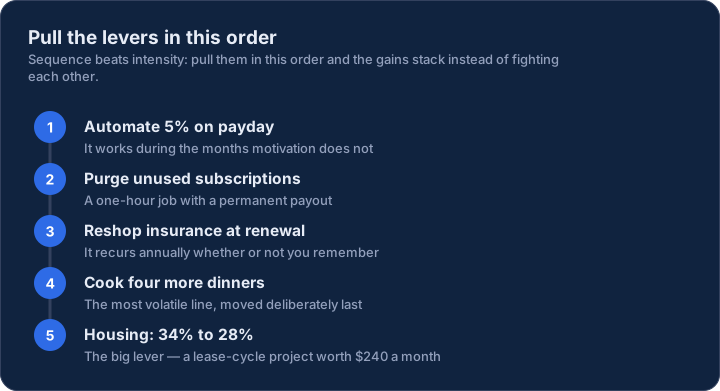
The order of operations is where most saving advice quietly fails. Automating even 5% on payday comes first, because it works during the months when motivation does not; the subscription purge comes second because it is a one-hour job with a permanent payout; the insurance reshops are third because they recur annually whether or not you remember them. Cutting groceries to the bone — the lever everyone reaches for first — comes last, if ever: food is the most volatile line, the least painful gap closes it, and starving the month to fund savings that get reabsorbed anyway is the definition of effort wasted. Pull them in that order and the gains stack instead of fighting each other.
| Lever | Typical monthly gain | Effort |
|---|---|---|
| Reshop insurance at renewal | $25–60 | one hour a year |
| Cancel / rotate unused subscriptions | $20–70 | ten minutes with the subscription audit |
| Four more home-cooked dinners | $80–140 | weekly plan |
| Phone plan to a discount carrier | $20–40 | one afternoon |
| Housing share 34% → 28% | $240 | lease-cycle project |
Frequently asked questions
How much should I save each month?
20% of take-home is the classic target; 5% is a legitimate start — trajectory beats the starting number.
Emergency fund or debt first?
One month of expenses in cash, then high-interest debt, then the full emergency fund.