Budgeting for Beginners: Start With One Number

Budget advice starts with a spreadsheet and ends with guilt. Start instead with one number: last month’s total spending. Four weeks to a working system.
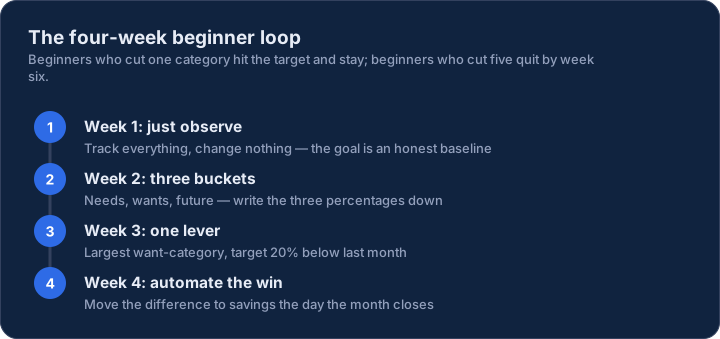
Week 1: Just observe
Track everything for one week without changing a thing. The goal is an honest baseline, not savings — most first-time trackers find 10-15% of spending they did not remember: subscriptions, delivery fees, cash leaks.
Week 2: Sort into three buckets
Needs (rent, food, transport), wants (everything optional), future (savings, debt payoff). No targets yet — seeing "wants = 42%" without judgment is the whole exercise. The number itself changes behavior.
Week 3: Pick one lever
Choose the largest want-category and set a target 20% below last month. One lever, one month. Beginners who cut five categories at once quit by week six; beginners who cut one hit the target and stay.
Week 4: Automate the win
Move the difference to savings the day the month closes — before it gets reabsorbed. Repeat. By month three the budget runs on a 10-second daily habit instead of willpower, which is the only kind that survives.
The first month on $4,000, in numbers
Here is what the four weeks typically surface on a $4,000 take-home: tracked spending of $3,340, of which housing $1,340 (34% — yellow, city rent), food $540 (13.5% — yellow, and delivery fees are a third of it), transport $410, utilities $250, fun $380, health $120, shopping $180, subscriptions $120. The gaps to the healthy caps — housing to $1,120, food to $480, subscriptions to $120 — free up roughly $290 a month without touching a single line of fun money. That is the beginner win: not a new lifestyle, one lever and $290. The budget health check runs this grading for you in a minute.
Reading your own gaps without guilt
The first honest month is never a grade, it is a map. A food line running 20% over its healthy cap does not mean you are bad with money — it means delivery fees are quietly renting space in your budget, and ending that one habit closes the gap without touching anything you actually enjoy. Every category works the same way: the gap points at a specific, boring, fixable behavior, never at your character. Beginners who treat the gap as information come back next month; beginners who treat it as a verdict quit by week six, exactly like the spreadsheets said they would.
When you miss a week
Every tracker has a dead week — travel, a project, life. The beginners who last treat the gap as data entry, not failure: back-fill the known amounts in five minutes (bank app open, tracker open), leave genuinely unknown cash spending as a single best-guess entry, and move on. Nothing about the method requires a perfect streak; it requires that the record resumes. A budget with one fuzzy week out of four still tells the truth about the other three, which is infinitely more than the person who quit in week two knows about their own money.
| Week 1 | Track everything, change nothing — the goal is an honest baseline, not savings. |
| Week 2 | Sort every entry into needs / wants / future; write the three percentages down. |
| Week 3 | Pick the single largest want-category and set a target 20% below last month. |
| Week 4 | Automate the difference to savings on the day the month closes; repeat next month with one new lever. |
Frequently asked questions
Do I need a budgeting app?
No — a tracker plus three buckets covers most of the value. Apps add convenience, not magic.
Irregular income?
Budget on your lowest recent month; treat anything above it as savings.